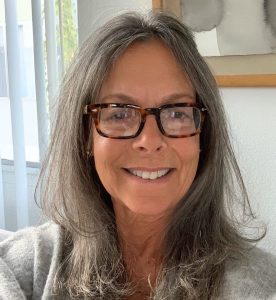
Words from others…

author: Art Historian, Jennifer Pellegrino

Towards Green Architecture


The Series presented here are paintings and sculptures created between 2020 and 2025 with Covid being an influential factor. A close relative of Zeljka’s and one who lived in her town, was one of the first to become infected. Derived from her many emotions, she said, “I made my first expressive nature paintings since it made me feel less anxious about the situation and because of the beautiful view I had in my studio surrounded by tall trees.”


ARCHITECTURAL PAINTINGS

The paintings in Series I are acrylic on canvas displaying an emphasis on the architectural engineering knowledge of the artist.

Distance III, painted in 2020, strategically has water set as a vanishing point that creates an illusion of depth and guides the viewer’s eye towards that very point of focus. On the horizon an entire city scape is placed. The painting’s sky, body of water and land surface is completely surrounded by shades of blue. The positioning of the city scape gives the viewer a sense of floating. Another positioning of the water is the grid like sidewalk and a multitude of cloud reflections which gives the viewer a sense of grounding. In its entirety, the painting clearly sets the viewer on a serene platform.
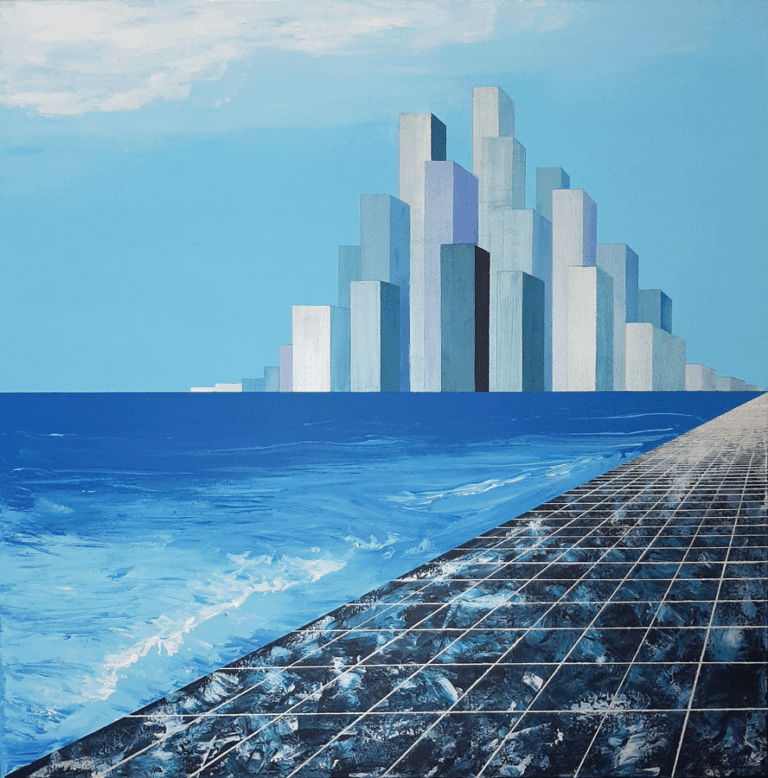
Distance III, 2020
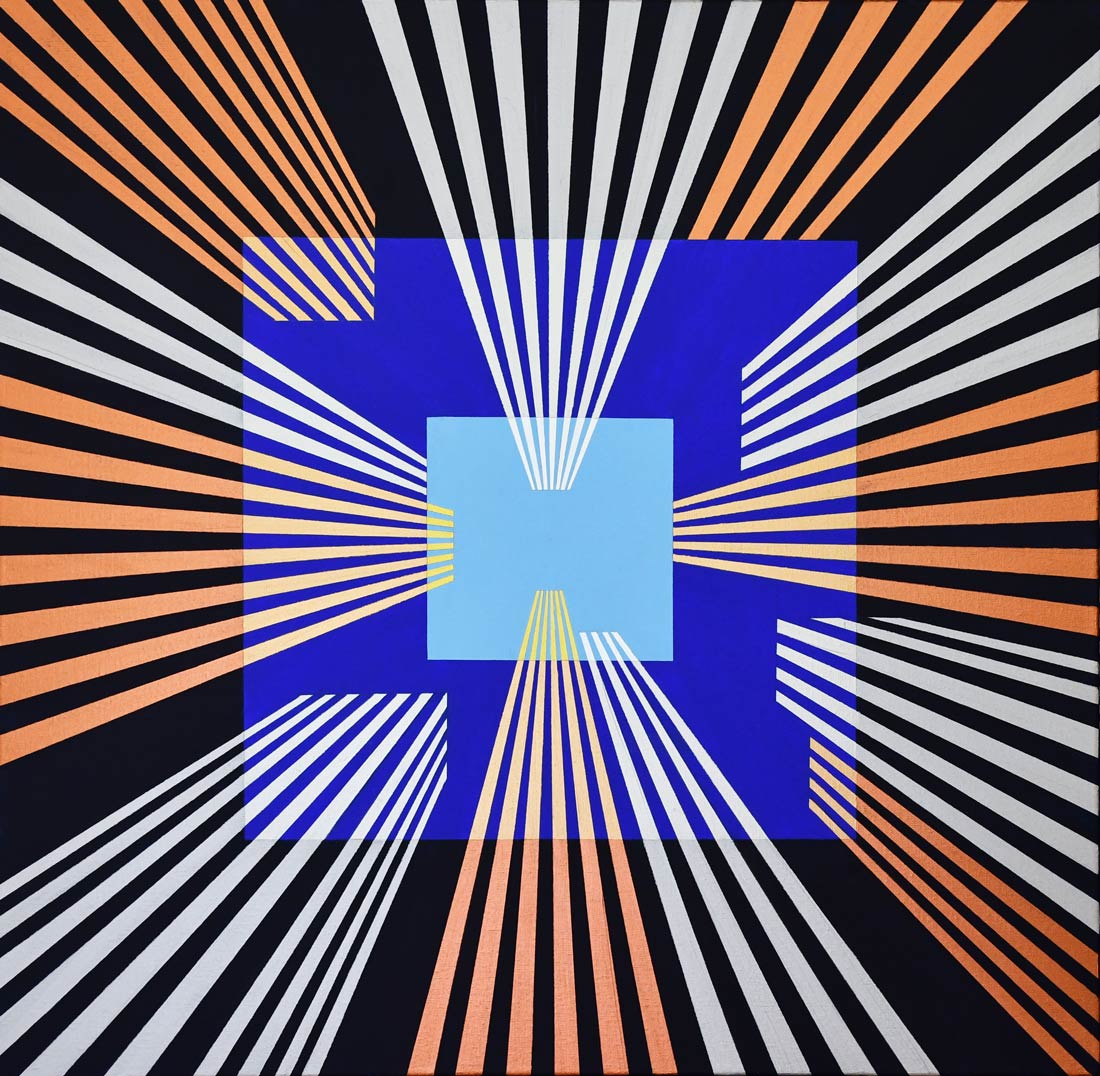
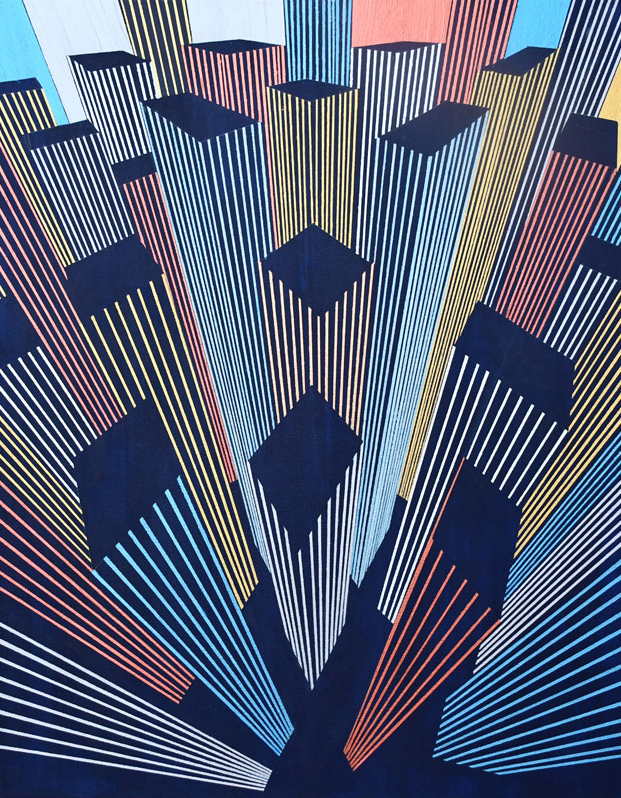
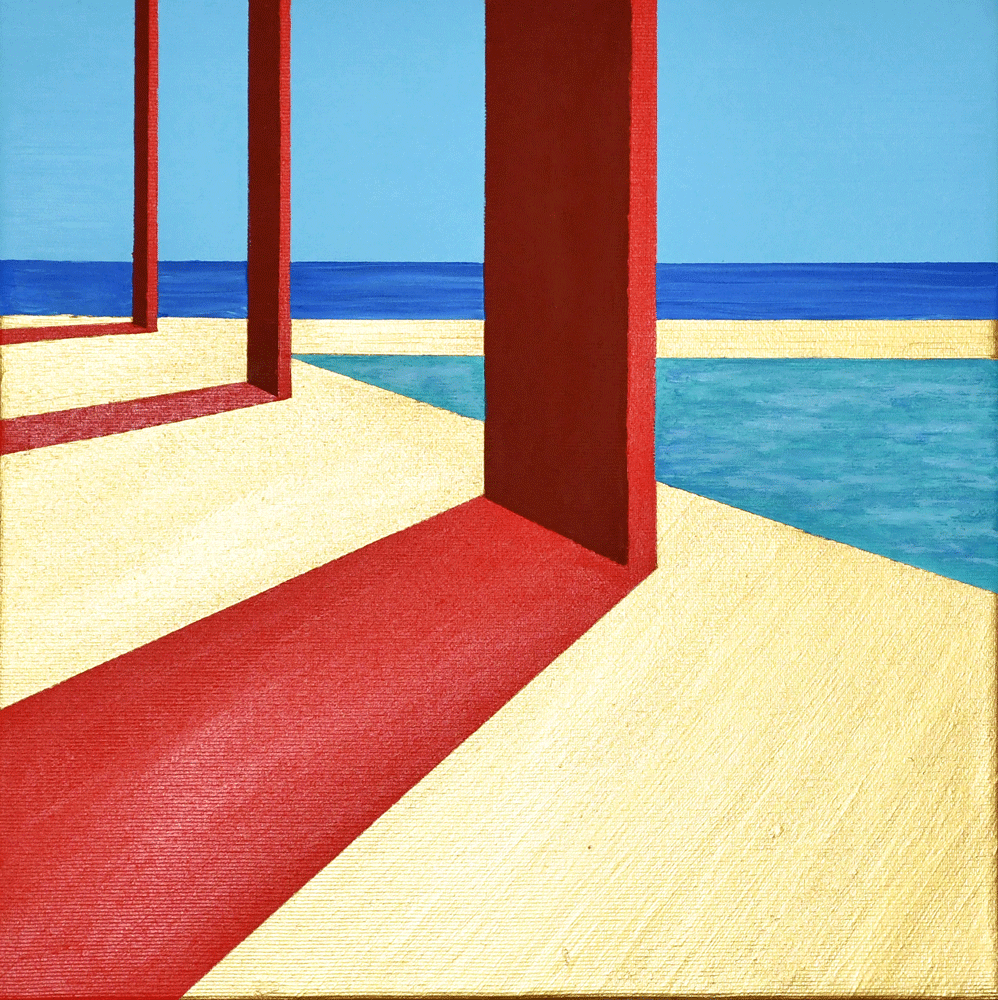
Moving along, we notice the vanishing point in each painting below. Each leads the eyes up in Looking Up V, down in Distance V and out in Escape V.

Emphasizing each painting looking like a sky scraper from bottom to top and top to bottom. In Escape V the detail appears to be grounded as if one is in the lobby of a skyscraper looking out to a pool then an ocean and up to the sky. This series is full of squares, rectangles and diamond shapes. There are thick and thin lines at right angles with flat surfaces. The colors in each painting derived from nature itself are shades of blue, terra cotta, orange, yellow and white. While the colors do not always blend they coordinate-allowing for a transition into a sense of growth. The transitions are incredible. Once again, up to the sky, down into the earth and then out and into the atmosphere. A physical push and pull as with nature itself.

FOCUS ON NATURE SERIES

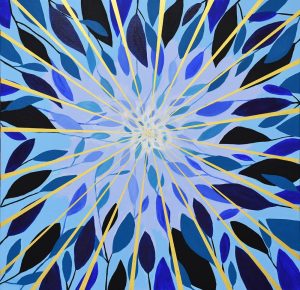
Focus on NatureXI painted in 2021 shifts from architecture into nature. The painting looks like a burst, or perhaps the inside of a flower with petals in full bloom. The artists use of squares, rectangles and diamond shapes as in Series I, where as here they appear as elongated oval shapes representing leaves painted in shades of blue. The blue shapes are static and share the space with yellow lines. Using the vanishing point leads the eye central to the painting while bringing a physical sense of push and pull as if one is watching the iris of an eye opening and closing due to the light. This painting may have been painted on a bright sunny day.

Focus on Nature XI, 2021

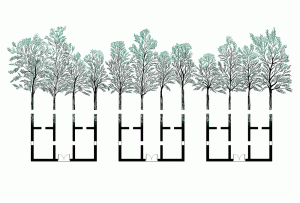
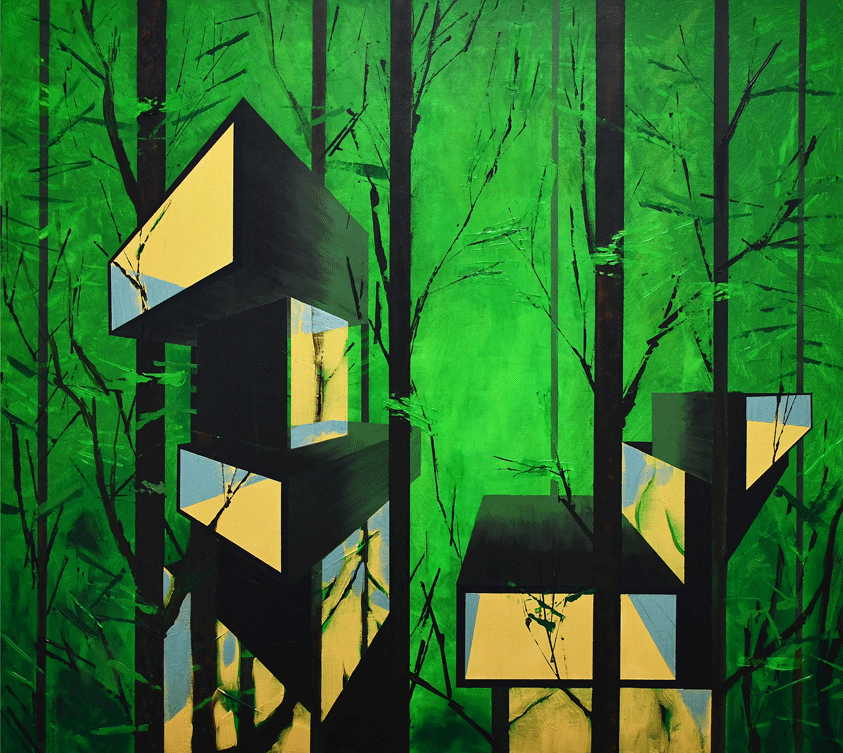
Green Architecture V 2022 created with the use of a computer, this digital work of art representing nature was a turning point for the artist. It is when she realized she had “achieved the real nature architecture connection for the first time.” This piece is the segue for the Green Architecture Art Project. It is an architectural design with slender black vertical lines for tree trunks and branches revealing delicate free form green sprouting leaves. This is as minimal at best and embodies pure natural and organic growth. The transition brings black and green on to the pallet for future paintings and sculptures by the artist.
Green Architecture V

ART BEYOND FRAMES SERIES

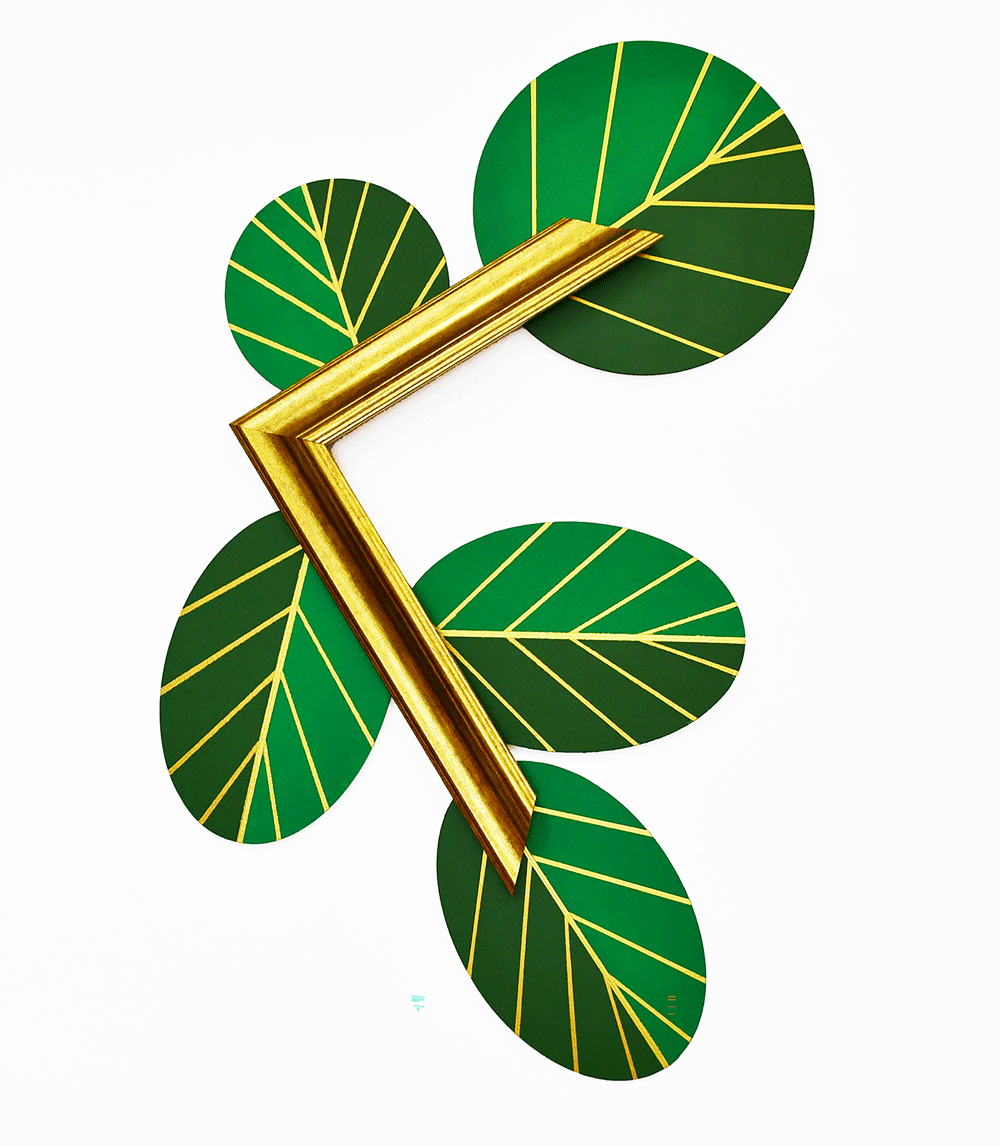
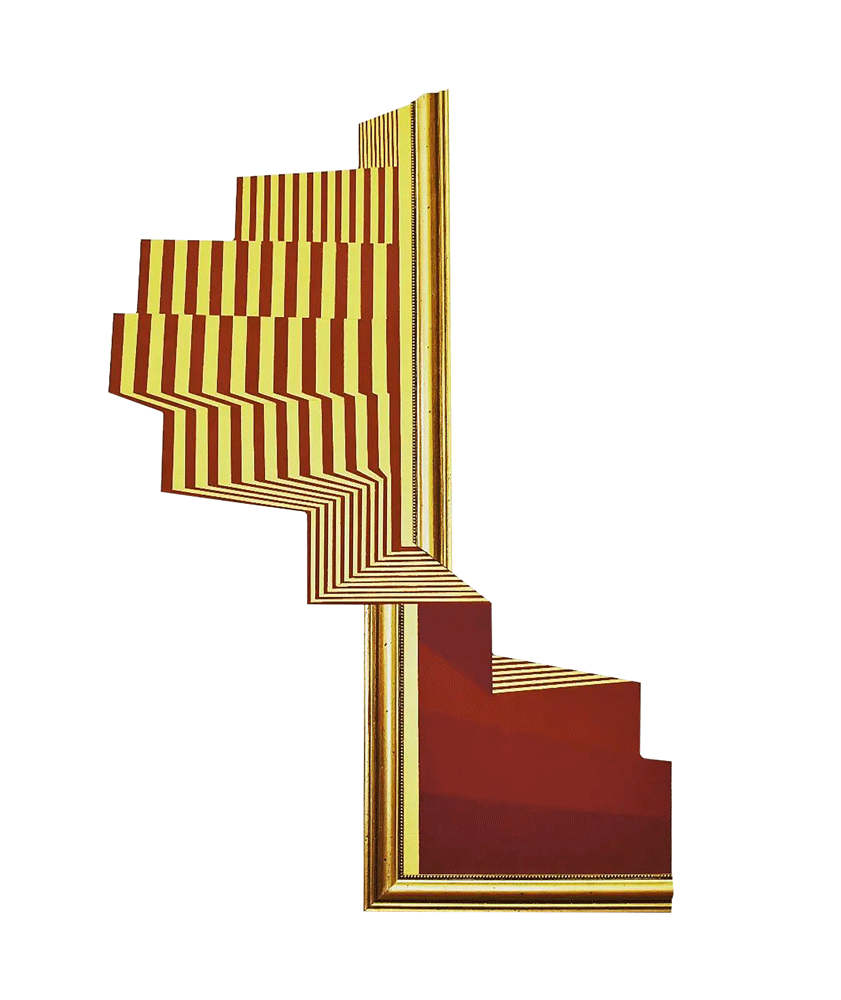
Curiosity 2022 and Branch 2023 are sculptures. Each is an offshoot from Series I and II. They are similar in lines, shapes and colors. In Curiosity 2022, the transition to a flat surface looking like a spiral staircase. The use of yellow and maroon, solids and lines allow for the sculpture to appear as organic as a spiraling DNA molecule while in accordance with nature itself! In Branch 2023 the artist uses shades of vibrant greens for leaves. The shape is natural and oblong. The gold can represent vascular lines allowing for the transport of water and other nutrients that are vital to all living plants. Still keeping with nature this sculpture has a corner of an actual frame eluding to sturdy branches. The colors, shapes and lines throughout Series III continue to strengthen the artists position and purpose of Green Architecture coming to life.

GREEN ARCHITECTURE SERIES

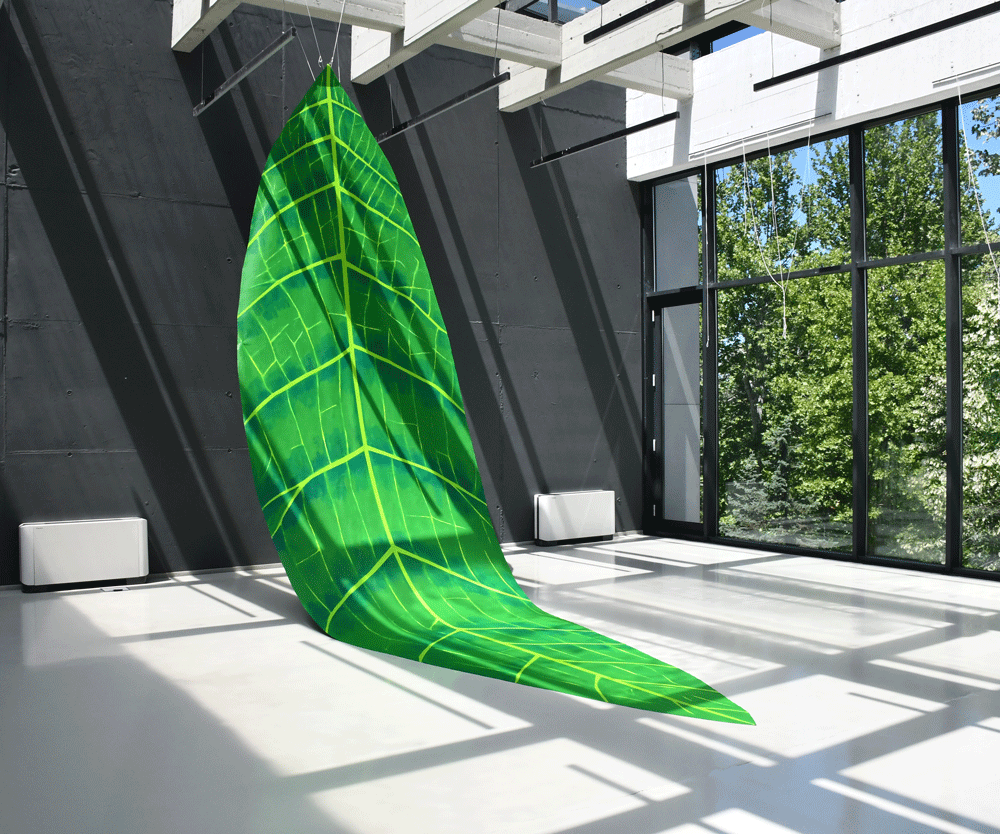
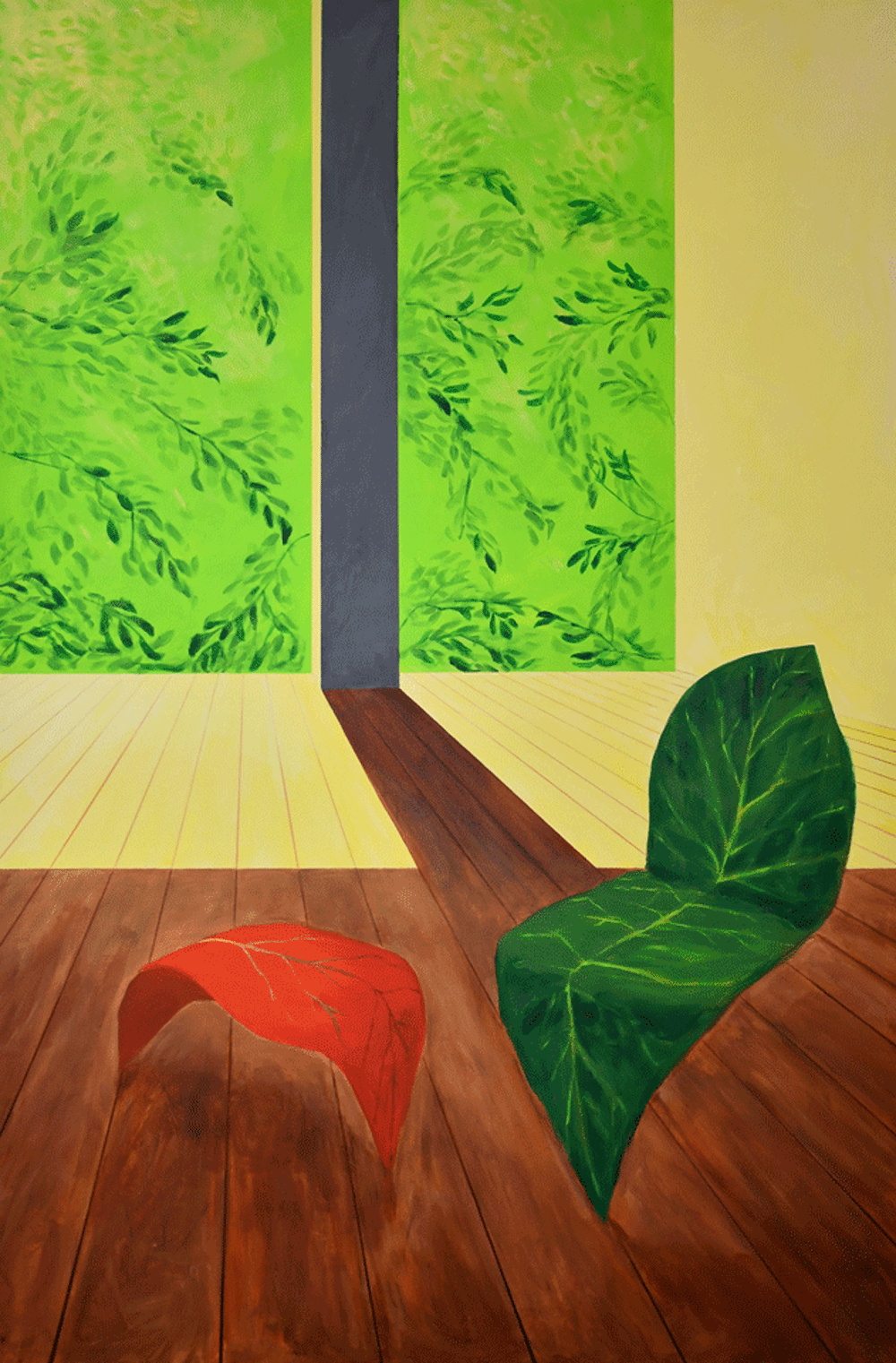
Funneling with Series IV-Green Architecture. The combination of these three paintings clearly exude architecture in nature. The threading and flow of curves, straight lines, squares, ovals, flat surfaces and colors from nature are in the leaves. Where there would be a perfectly blue sky, it has transformed into green. The Leaf Installation I and Green Architecture display creative thought to soaring heights and broad widths. Green Architecture VIII has plank width lines forcing the eyes to look outside square boxes towards a green sky, or maybe land. Inside the box is a brown floor with similar plank lines. On the floor are fall colored leaves of orange and a dark green in a leaf shape appearing to be chairs. The  wall is yellow. The colors in Series IV are an off shoot (no pun intended) to the descriptions of the previous three series of work.

Extraordinary works in their  simplicity have been described representing architecture in nature and nature in architecture.

ANALYSIS

This will be a general analysis pertaining to most, if not all the works attempting to achieve the following:

  • Recognizing line/shape/color/light used and how they dominate, or play different roles.
  • Is there a scene, or are elements used abstractly.
  • What is the focal point.
  • Has the visual effect or mood been achieved.


The use of various earth tones throughout the works portrayed can place the viewer in precarious, uncomfortable and comfortable spaces. The powerful use of lines, curves, shapes and angles create abstract places. Places as simple as being inside a home. The viewer is taken to heights unimaginable from above a skyscraper looking down. On the ground looking and peering into the distance. Inside looking out. The locations of each painting places one inside and outside while being embraced by nature. The viewer feels as if he or she is a part of an entire orbit within a particular surrounding in a particular environment. The visual effects in each work provide extraordinary moods. 

INTERPRETATION

The names of some of the abstract paintings lends little to the scene itself with vertical and horizontal lines, diamond shapes and flat surfaces appearing to be skyscrapers that could be something else. This allows freedom to the viewer to interpret and make up their own name for the painting or sculpture. The statements made on the works are broad in scope allowing the viewers own meaning and how it relates to their life as well as feelings the works conjure. In other cases the works are not abstract and symbolize the natural environment clearly depicting leaves, water, trees, branches and sky. The various statements reveal the very reason the artist might have chosen to title this series Green Architecture.

EVALUATION-COMPARE AND CONTRAST

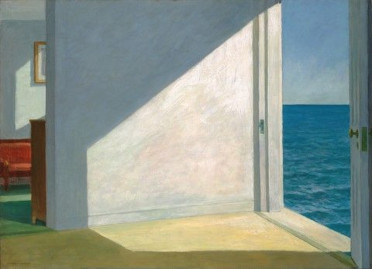
The evaluation of the artists work will be compared to four masters who have conveyed beautiful, insightful connections to the importance of perspective in architecture and nature over centuries. The works of art have made significant value in communicating ideas and rules of personal expression. Series I, Escape V reminds me of Edward Hopper’s painting, Rooms by the Sea. Each painting is realist with abstract and surreal qualities to be considered. The void of humanity is powerful while evoking comfort, silence and serenity with the clean lines, blue water and sky.

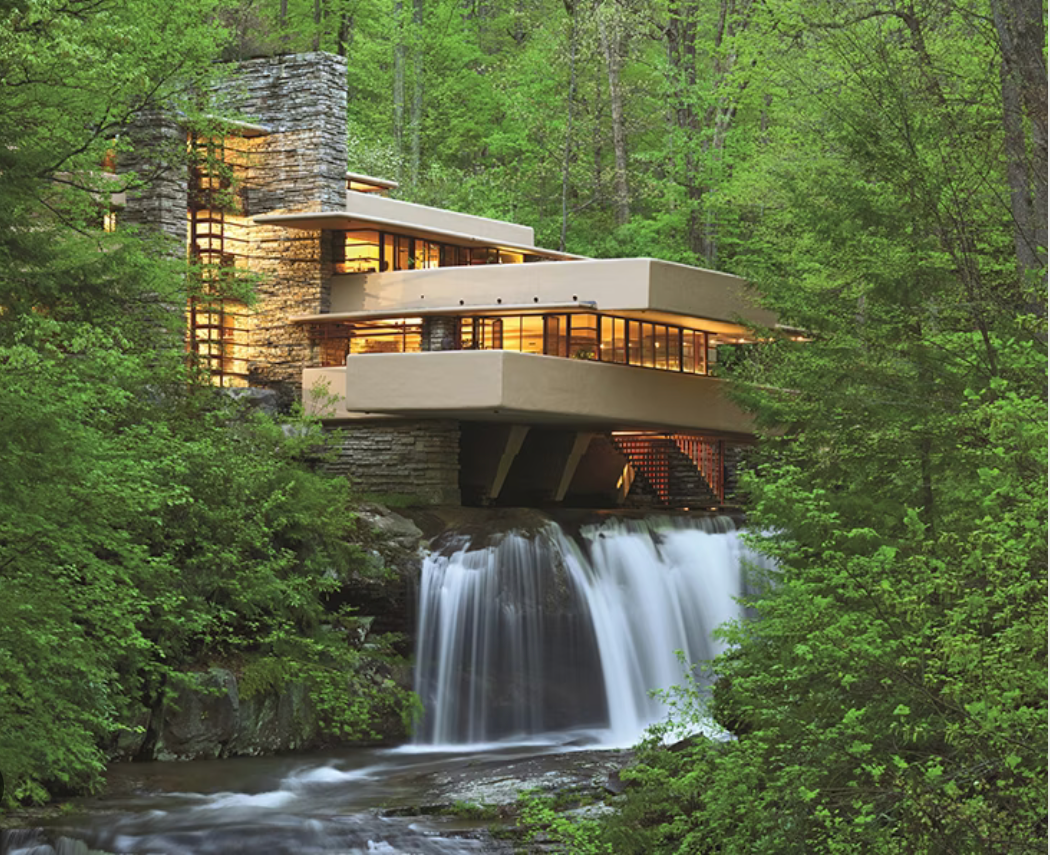
From Series IV, Green Architecture is compared to the master of architecture, Frank Lloyd Wright’s Fallingwater. The ultimate in green architecture is being surrounded and completely engulfed by nature. Each artist has created, if you will, a bipartisanship within nature. Living in treehouses, above the earth, painted by the artist, or above a waterfall surround by space, places one floating in the comfort of an organic and modern cantilevered structure. Each work reminds us of how incredible one can enjoy and live in harmony with nature.

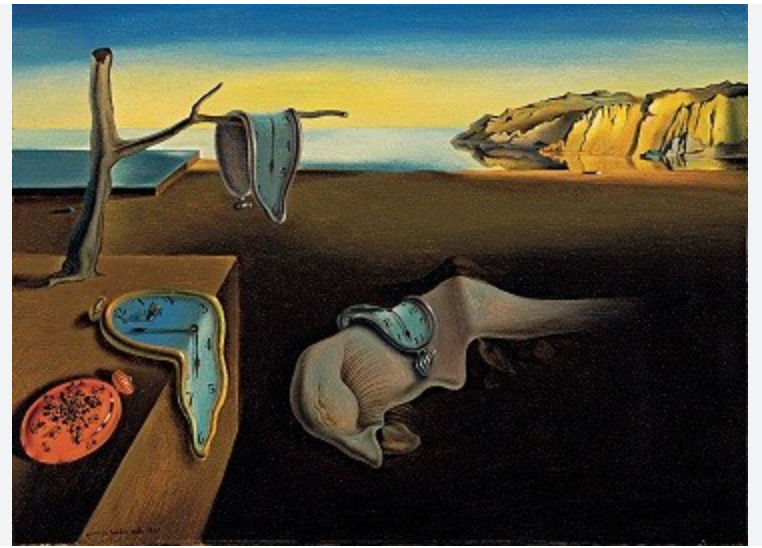
The evaluation of Green Architecture VIII is compared to the master of surrealism. Salvador Dali and his surrealist painting, Persistence of  Memory. Whether intentional or not the artist worked with a similar palette as Dali and the notion of time itself. The two different colored leaves perhaps symbolize a particular season. The distortion of each leaf portrays the end of a time in that very season. There is no actual tree from which the leaves drop from, but rather the long wide lines representing the tree trunk itself. This surrealist painting is a prime example of the subconscious mind getting into the world of dreams. Time and nature are key elements along with the exploration of the human psyche intriguing any viewer.

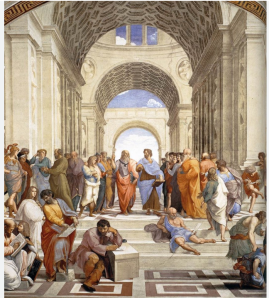
The final evaluation pertains to the entire series. Each piece is similar to each other. Their composition is similar in scale while the placement of manmade (buildings), or natural structures (trees) coincide with nature. Most paintings represent the use one-point linear perspective to draw the viewer’s eye to the center of the scene. While there are no central figures in any of the paintings, the position of various objects signify the artists emphasis on nature in observance of/to the physical environment. The context in which the artists paintings were created was to represent the importance on how dovetailing from architecture into nature-with sensitivity to our ever changing environment and by creating her own Green Architecture Series. How significant each one of the paintings or sculptures has to each of us is extremely individual and sensitive. The skill in which the artist used composition, perspective and her ability to convince complex ideas through visual art has been successfully achieved. Much of what I observed throughout this critique is that there is architecture in nature. Now, if only we could learn to enjoy art more. Relax our body and mind and understand how profound the Green Architecture Series naturally falls in line and perspective with this masterpiece by the master himself. Raphael’s “School of Athens.”

Raphael, The School of Athens